
K-pop 2025 Year-End Review: Tours, Global Charts, and Short-Form Momentum—What the 2026 Outlook Suggests
K-pop in 2025 was defined less by any single metric and more by how multiple indicators moved together: touring demand, global chart visibility, short-form distribution, cross-market buzz, and release strategy. A clear year-end signal is “full-spectrum metrics,” where a song or album can shape Billboard 200 headlines, tour routing in North America and Europe, short-form re-circulation, and next-year scheduling. Using several groups as case studies, this feature breaks down five core indicators from 2025 and outlines what remains trackable heading into 2026.
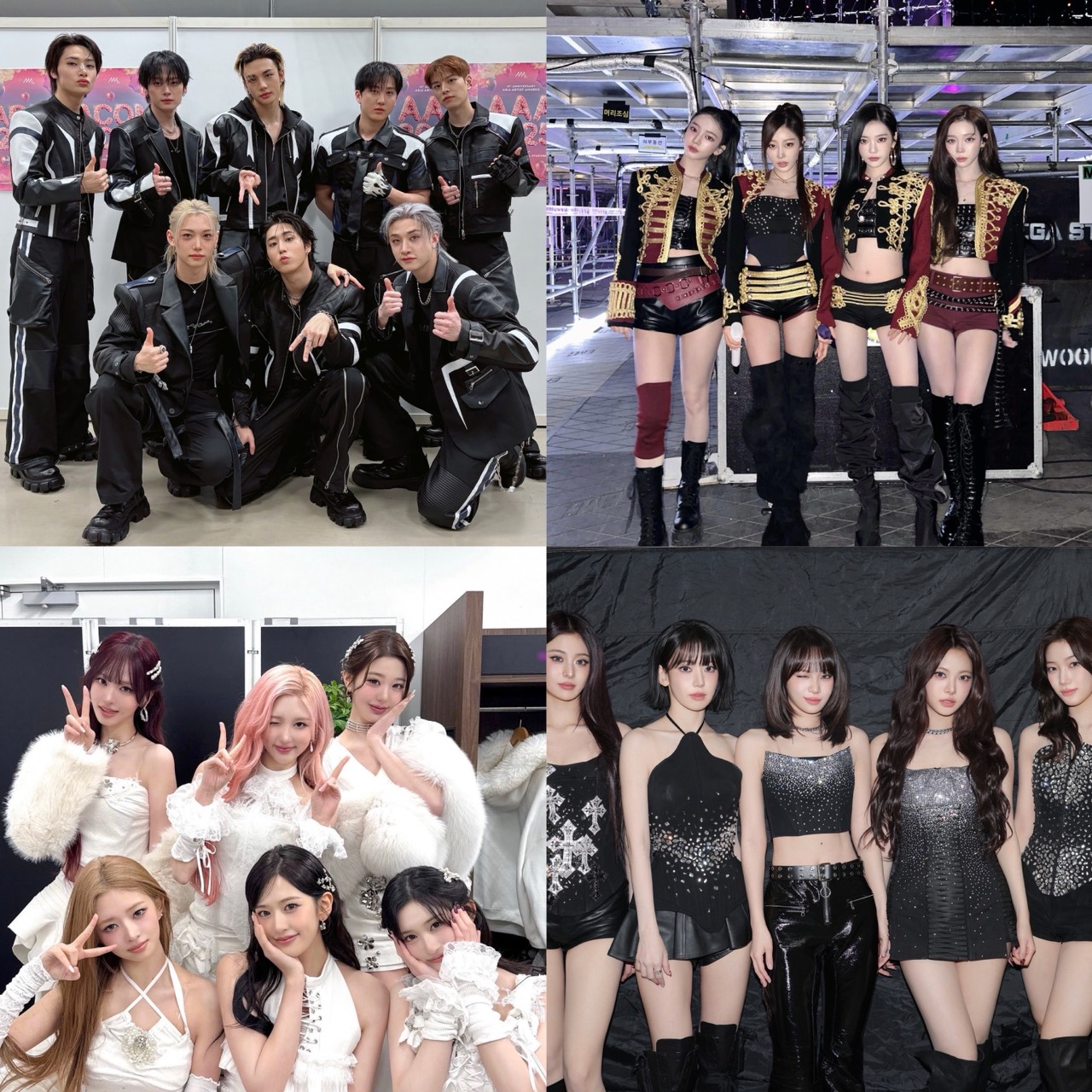
Indicator #1 is touring demand and global mobilization. Stray Kids’ 2025 was described as a year of record-setting momentum, anchored by a world tour spanning major cities across North America, Europe, and Asia. Billboard’s “Top Tours 2025” list placed them at No.10—the highest rank among K-pop artists on that chart. Touring metrics matter because they reflect more than a single-market spike; they shape the next year’s priorities, from venue size and city density to promotional investment. As touring becomes a comparable, headline-ready metric, K-pop competition maps more directly onto the global live-entertainment market.
Indicator #2 focuses on release outcomes and musical strategy—where different paths became especially visible in 2025. Stray Kids maintained strong album-facing metrics: their 2025 full-length ‘KARMA’ and SKZ IT TAPE ‘DO IT’ were described as achieving seventh and eighth consecutive Billboard 200 entries, both debuting at No.1, alongside mention of milestones tied to Billboard 200 No.1 counts and streaks. By contrast, aespa’s case highlights strategy and global media framing: ‘Dirty Work’ and ‘Rich Man’ presented distinct sonic directions, and the U.K.’s The Times praised the group as already “formidable” without needing genre adjustments—while also awarding what was described as the publication’s highest score for K-pop album reviews. IVE, meanwhile, were described as running a high-frequency release cycle—starting with the January pre-release ‘Rebel Heart,’ followed by ‘IVE EMPATHY’ and ‘IVE SECRET,’ plus a Japan release ‘Be Alright’—while also linking to major overseas stages such as Lollapalooza Berlin, Lollapalooza Paris, and Rock in Japan Festival 2025, and opening their second world tour ‘SHOW WHAT I AM’ at KSPO DOME. In year-end terms, 2025’s “results” were as much about how strategy translated into durable visibility—and how releases and stages reinforced each other—as about rankings alone.
Indicator #3 is short-form distribution and the second life of tracks. In 2025, year-end reviews didn’t stop at first-week peaks; they also tracked how songs were re-edited, re-used, and re-circulated across platforms like TikTok and YouTube Shorts. TWS’ ‘OVERDRIVE’ gained traction through the “앙탈 challenge,” reaching No.6 on TikTok Music’s Viral 50, approaching 100,000 user-generated clips, and coinciding with sustained chart presence—six weeks on Melon’s weekly chart and a 17-place rise on Bugs’ daily chart—illustrating a “short-form surge → streaming curve rebound” pathway. BOYNEXTDOOR’s ‘오늘만 I LOVE YOU’ appeared in YouTube Korea Shorts’ Top 10 popular tracks list at No.10 and entered Billboard’s Global 200 and Global (Excl. U.S.) charts; follow-up coverage also cited 1.16 million first-week album sales. As short-form becomes a distribution mechanism that can alter a song’s lifecycle, year-end analysis naturally shifts toward curves and momentum rather than single moments.
Indicator #4 is global-market traction and cultural export—how narratives travel across different audiences. LE SSERAFIM’s 2025 was positioned across multiple global-chart coordinates: they were described as achieving the highest rank among K-pop girl groups in Oricon’s annual single ranking, while also placing all releases within the stated tracking period onto the rankings. On the song side, ‘SPAGHETTI (feat. j-hope of BTS)’ ranked No.7 on Amazon Music’s “Best K-pop of 2025,” ‘HOT’ at No.18, and ‘Ash’ at No.9 on NME’s “Best K-pop 25.” Touring was also noted via Billboard’s “Top 10 Highest Grossing K-Pop Tours of the Year,” where they ranked No.8, with an encore in Seoul scheduled for Jan 31–Feb 1, 2026. Another case is P1Harmony: ‘Pretty Boy’ was selected for The Hollywood Reporter’s “40 Best K-pop Songs of 2025,” the group appeared on “The 2025 Billboard K-pop Artist 100,” and both ‘DUH!’ and their first English album ‘EX’ were described as charting on the Billboard 200, with ‘EX’ debuting at No.9. The throughline is that 2025’s global market wasn’t only about one-time spikes, but about repeated recognition across different chart systems and media lists.
Indicator #5 is the 2026 outlook—not as prediction, but as an extension of observable patterns. First, the touring market remains the most legible globalization metric, with quantifiable sales and mobilization rankings increasingly shaping where resources flow. Second, girl-group trajectories will continue to balance between strategy and global framing: one route builds long-tail visibility through sonic positioning and media evaluation, while another advances through high-frequency releases and dense stage schedules, extending activity into longer tour cycles. Third, short-form will remain a key tool for lifecycle management, compressing the gap between “comeback” and broader public traction and helping subsequent releases inherit momentum. Fourth, cross-language and cross-platform chart narratives will keep influencing how the public defines “success.” For readers, the most practical way to follow 2026 is to track these measurable indicators—because what ultimately enters year-end summaries is rarely a single moment, but the convergence of multiple metrics rising within the same window.